Brand Foundation
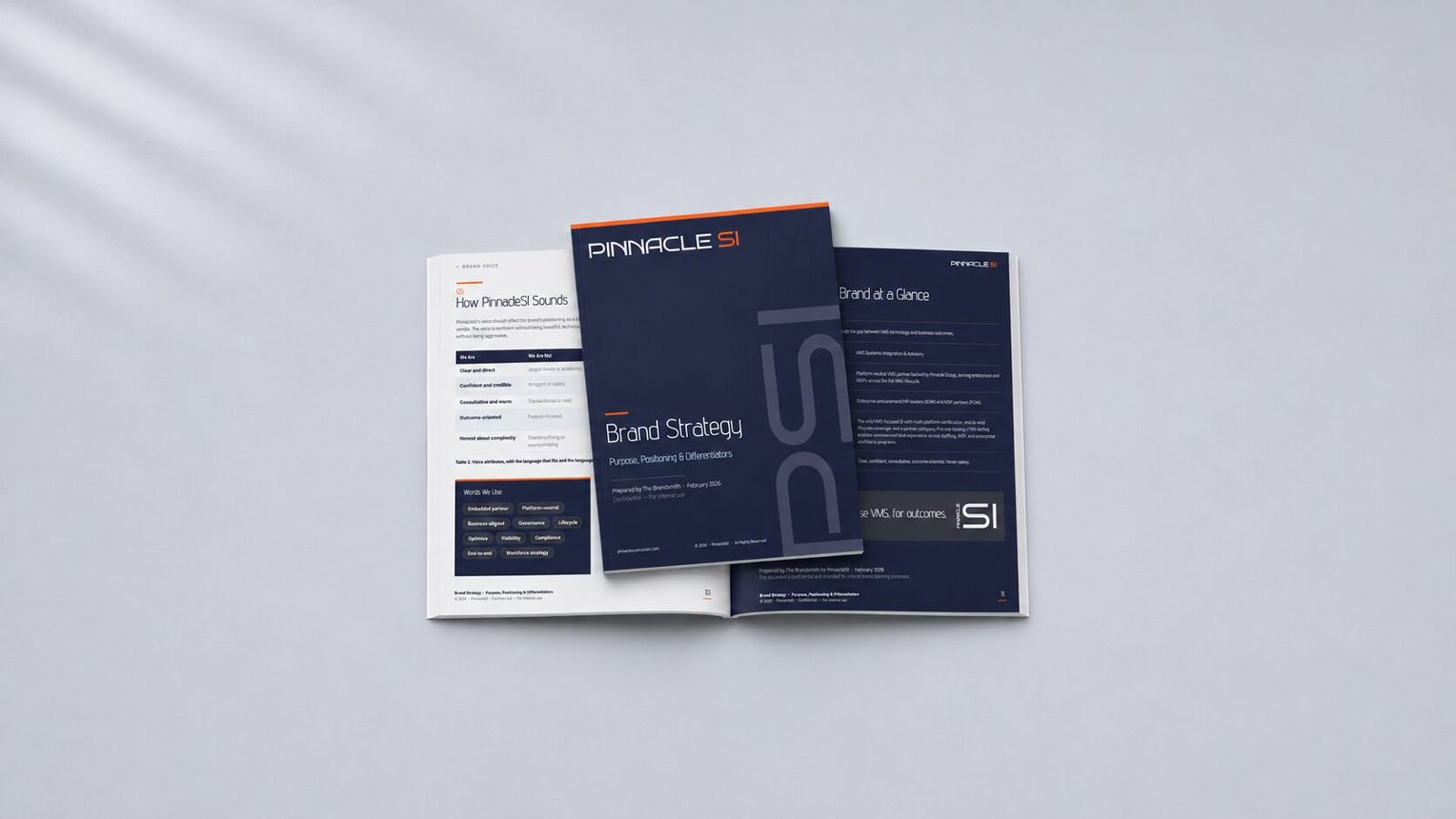
Purpose, positioning, and differentiation strategy. Competitive analysis, target audience and use case definitions, channel partner considerations, and a focused brand guidelines document.
A high-value advisory practice was trapped inside larger contracts, invisible to the buyers who wanted it. We defined and built the brand that gave that demand somewhere to land. Start to launch in six months.
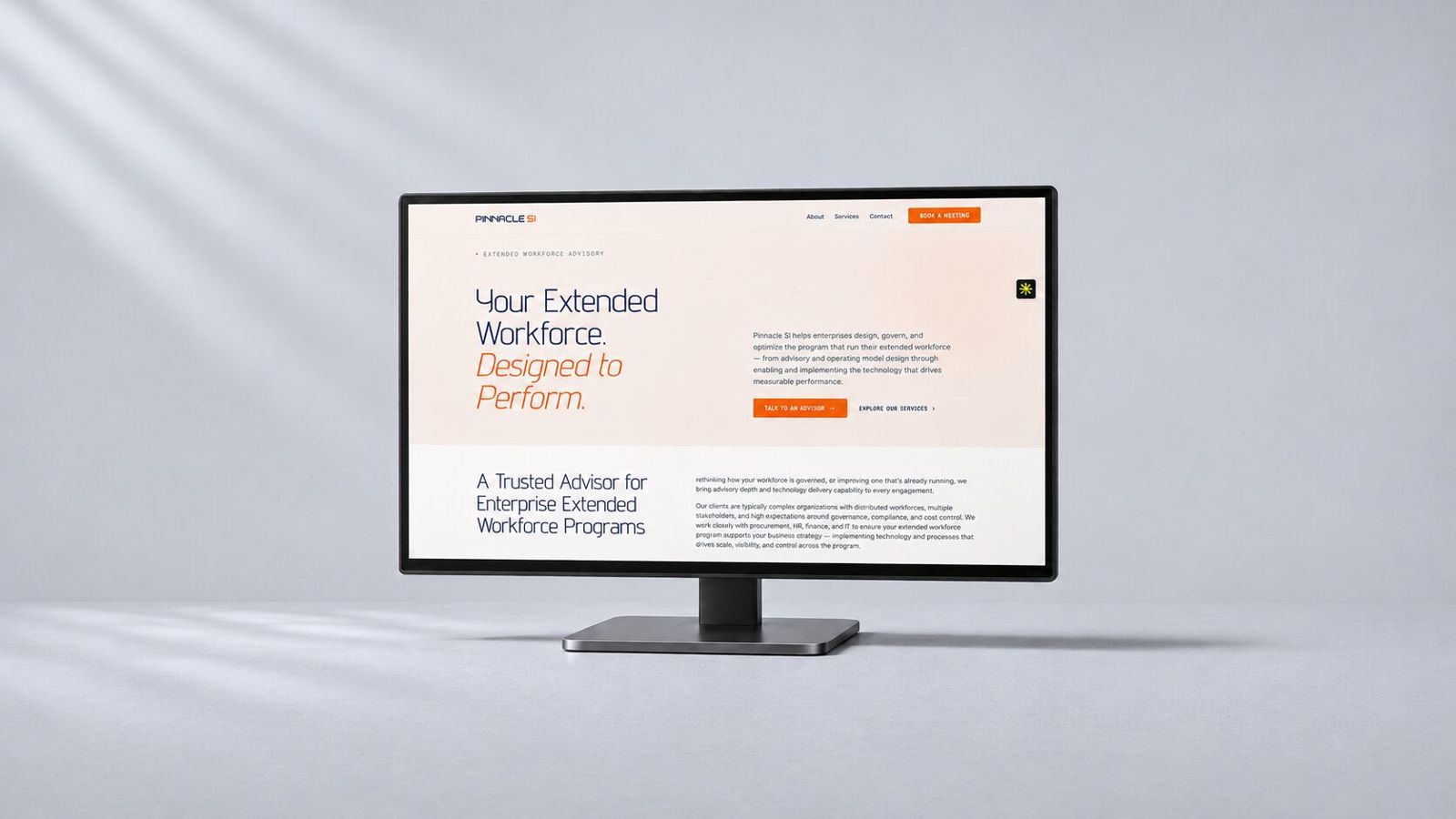
PinnacleSI launched in 2026 as the dedicated brand for extended workforce advisory and planning, supported by technology delivery spanning VMS implementation and configuration, Workday module implementations, and broader workforce technology integration. The brand addresses the growing population of enterprise buyers who need strategic external workforce advisory, and the technology execution to act on it, outside the scope of a managed service program engagement.
But before PinnacleSI existed, the work it now represents was delivered as part of broader engagements rather than as a standalone offer. Extended workforce advisory and the technology implementation work that supports it were being delivered as capabilities folded inside larger MSP contracts under the Pinnacle Group brand. Clients who wanted advisory and execution work without committing to a full managed program had no clear way to engage the firm for it.
This is a quietly common pattern in workforce solutions: high-value advisory work gets compressed into adjacent service categories because there’s no dedicated brand to carry it standalone.
Pinnacle leadership saw the demand pattern emerging across multiple inputs and made the strategic decision to give that demand somewhere to land.
Pinnacle Group had identified the need. The market signal was clear from inside the business: prospects asking about workforce advisory and standalone tech implementation as discrete needs, RFPs scoped narrowly around advisory and configuration work, and a pattern of referrals from Beeline, SAP Fieldglass, Workday VNDLY, and Workday ecosystems for partners who could deliver advisory and implementation expertise without requiring an MSP engagement. The strategic call had been made: the work needed its own brand.
What we were brought in to define was the harder question: what should that brand be, who should it speak to, and how should it sit alongside Pinnacle Group and PTR Global without re-introducing the same confusion the new brand was meant to solve?
The work being delivered inside MSP contracts was sophisticated. But because it was expressed as a sub-capability of a larger service, three things were happening. Buyers couldn’t find it: a workforce strategy lead at a Fortune 500 wouldn’t naturally search Pinnacle Group, because Pinnacle Group reads as MSP. Channel partners couldn’t refer to it cleanly: platform partners want to refer to a focused specialist, not the implementation arm of a larger MSP firm. And sales conversations were friction-loaded: every conversation started with disambiguation, and every disambiguation is a moment where deals slow down.
Pinnacle approached us with the strategic need to establish a new brand. What we led was the work that defined what the brand should be: positioning and differentiation strategy, competitive analysis, audience and use case definition, the architectural logic for how PinnacleSI should sit alongside Pinnacle Group and PTR Global, and the brand build itself.
The decision to launch a new brand was Pinnacle’s. The strategic work to make that brand land was ours.
That’s a different kind of partnership: the client trusts the embedded partner with the strategic substance of brand decisions, not just their creative expression. The architectural answer was a separate brand, focused, advisory-led, with its own buyer, its own sales motion, and its own clear relationship to the platform ecosystem. From need identified in summer 2025 to brand launched in 2026, the engagement ran across eight phases, from discovery and brand alignment through identity development, documentation, collateral, content, website design, development and launch, and channel partner co-marketing.
When we made the strategic decision to establish PinnacleSI as a dedicated brand, we needed a partner who could take that decision and turn it into a real brand. One that would actually solve the market access problem the launch was meant to address.
Six months from start to launch, with a complete brand system standing behind it. The result is a brand that finally lets our extended workforce advisory and technology delivery work be heard by the buyers who were already asking for it.
Purpose, positioning, and differentiation strategy. Competitive analysis, target audience and use case definitions, channel partner considerations, and a focused brand guidelines document.
Logo developed across multiple concept directions and refined through committee and executive review, plus a full color palette, typography system, iconography, and foundational visual language.
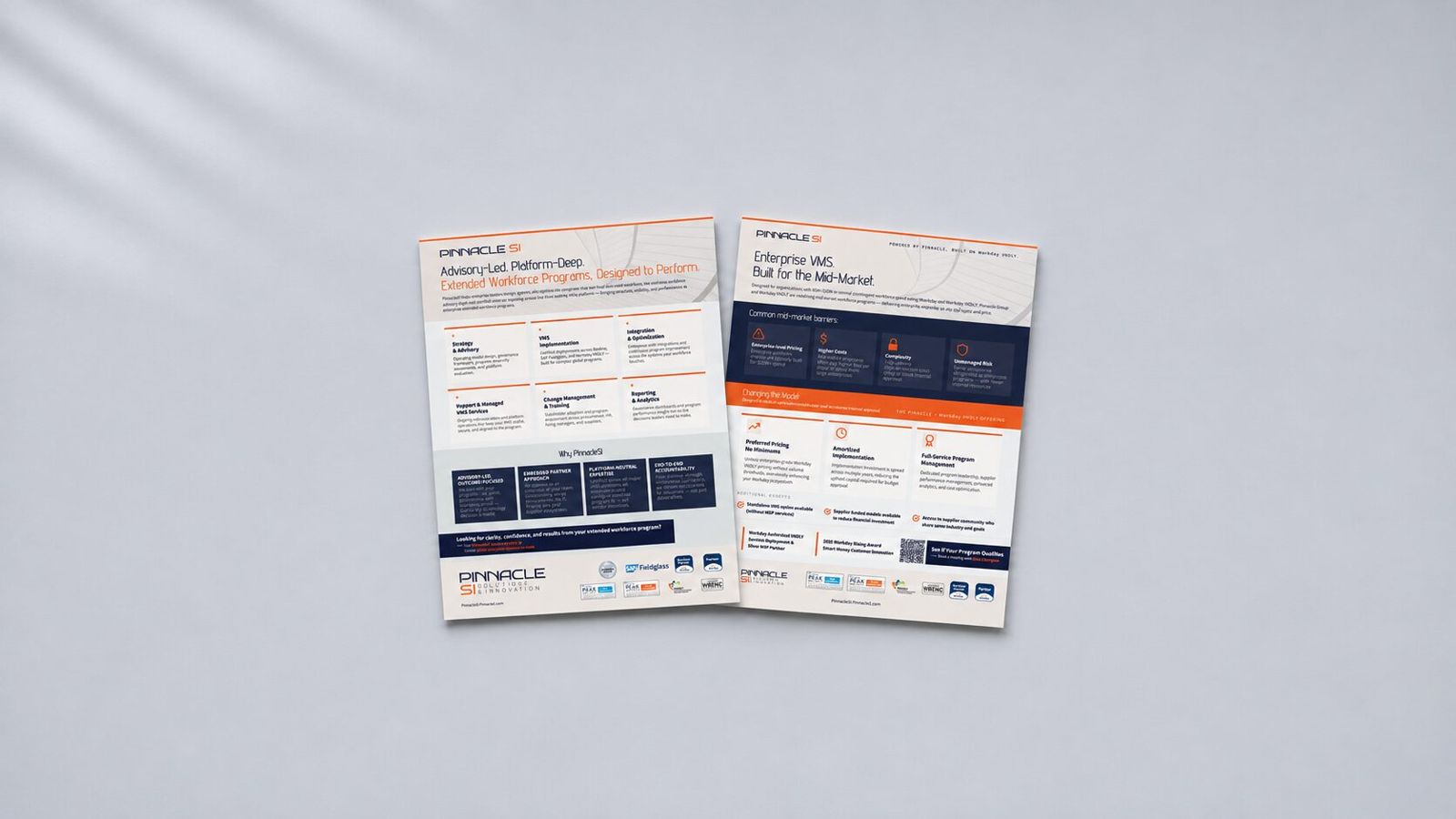
Service overview, presentation templates, business cards, banner stands, a LinkedIn and social post library, and an email template system with three header and five content layout variations.
Content strategy and editorial framework, a weekly post cadence mapped to key services, and a curated industry post cadence built to keep the brand active without constant net-new production.
Sitemap, content framework, high-fidelity UI, responsive build across seven page types, WordPress configuration, front and back-end development, forms, SEO foundations, and launch support.
Co-marketing strategy alignment and partner opportunity scoping across the platform ecosystem: Beeline, SAP Fieldglass, Workday VNDLY, and broader Workday integration.
PinnacleSI launched in 2026, so the longest-tail outcomes are still ahead. But the immediate effects are real and worth naming.
Sales conversations no longer require disambiguation. A workforce strategy lead at a Fortune 500 looking for advisory and implementation support now finds a brand whose first-screen positioning matches their search exactly. Channel partners have a clearer referral target: Beeline, SAP Fieldglass, Workday VNDLY, and Workday ecosystems can refer prospects to a brand that reads as a focused specialist. And the Pinnacle Group portfolio finally expresses its three audiences distinctly: Pinnacle Group reads unambiguously as MSP, PTR Global reads as staffing, and PinnacleSI reads as extended workforce advisory and the technology delivery that executes on it.
Three brands, three buyers, three sales motions. Each finally able to speak to its own audience without confusion.
Most partners spend their time treating the symptoms. We work the foundation. We stabilize what’s settled. We elevate the brand to where the work already lives. We hold the structure steady so the firm can finally show up the way it actually performs.
PinnacleSI is what that looks like when the strategic question is “we know we need a new brand, what should it actually be?” Pinnacle saw the market signal and made the strategic call. The work that fell to us was the harder question: defining the brand’s positioning, audience, competitive frame, and architectural relationship to the broader portfolio, then building it as a complete go-to-market system in six months.
When the client makes a strategic move, the embedded partner is trusted with the substance of how that move gets made, not just the creative wrapping.
That’s what an embedded partnership since 2014 produces. Not just better creative, but the standing to be trusted with brand decisions that shape how the business shows up to its market.
PinnacleSI is the Pinnacle Group brand for extended workforce advisory and planning, supported by technology delivery spanning VMS implementation and configuration, Workday module implementations, and broader workforce technology integration. It launched in 2026.
Advisory and implementation work was folded inside larger MSP contracts. Buyers couldn’t find it, platform partners couldn’t refer to it cleanly, and every sales conversation started with disambiguation. A dedicated brand gave that demand somewhere to land.
Six months from start to launch. The need was identified in summer 2025 and the brand launched in 2026, across eight engagement phases from discovery through channel partner co-marketing.
Positioning and differentiation strategy, competitive analysis, audience and use case definitions, the brand architecture alongside Pinnacle Group and PTR Global, and the full build: visual identity, documentation, collateral, content, website design and development, and channel co-marketing.